
In April 2023, the world was a different place. King Charles was preparing for his coronation. The passport office was on strike. The final series of Succession had just been released, and no one had even heard of Barbenheimer.
And AI was also very different to how we know it now. The free version of ChatGPT handled text only. Image input, such as photos of handwritten scripts, wasn’t widely available until September 2023. It regularly “hallucinated”, confidently inventing statistics, quotes and references. It also had no live internet access in the free version, so its knowledge stopped in September 2021. It was also weak at arithmetic and couldn’t analyse a spreadsheet unless you pasted the data in – and even then it made errors.
Now we are three years on from that point; it feels like a good time to look back and compare how current use matches up with the predictions made by Tappers in 2023, when we asked how you expected AI would be used in the future.
Used far more than expected
Parent communications: In primary, senior leaders are using AI for parent communications far more than they expected. Its use is up 28 points, roughly doubling from about 28% to 56%. The picture is similar among secondary senior leaders, where it’s up 10 points.
Lesson planning in primary: Primary classroom teachers’ use of AI for planning is up 16 points (from 39% to 55%). Secondary is also above prediction for both groups, but only by 5 points.
Used far less than expected
Data analysis: These are the biggest falls on the chart. For AI analysis of attainment data, primary teachers were down 27 points (34% to 7%), and secondary teachers were down 25 points. AI analysis of behaviour data looks very similar with secondary leaders down 26 points and secondary teachers down to 24 points – down to almost nobody!
Marking in secondary: this was down 24 points for both teachers and leaders, from about a third to under 10%.
Homework: Using AI for homework was down across primary and secondary.
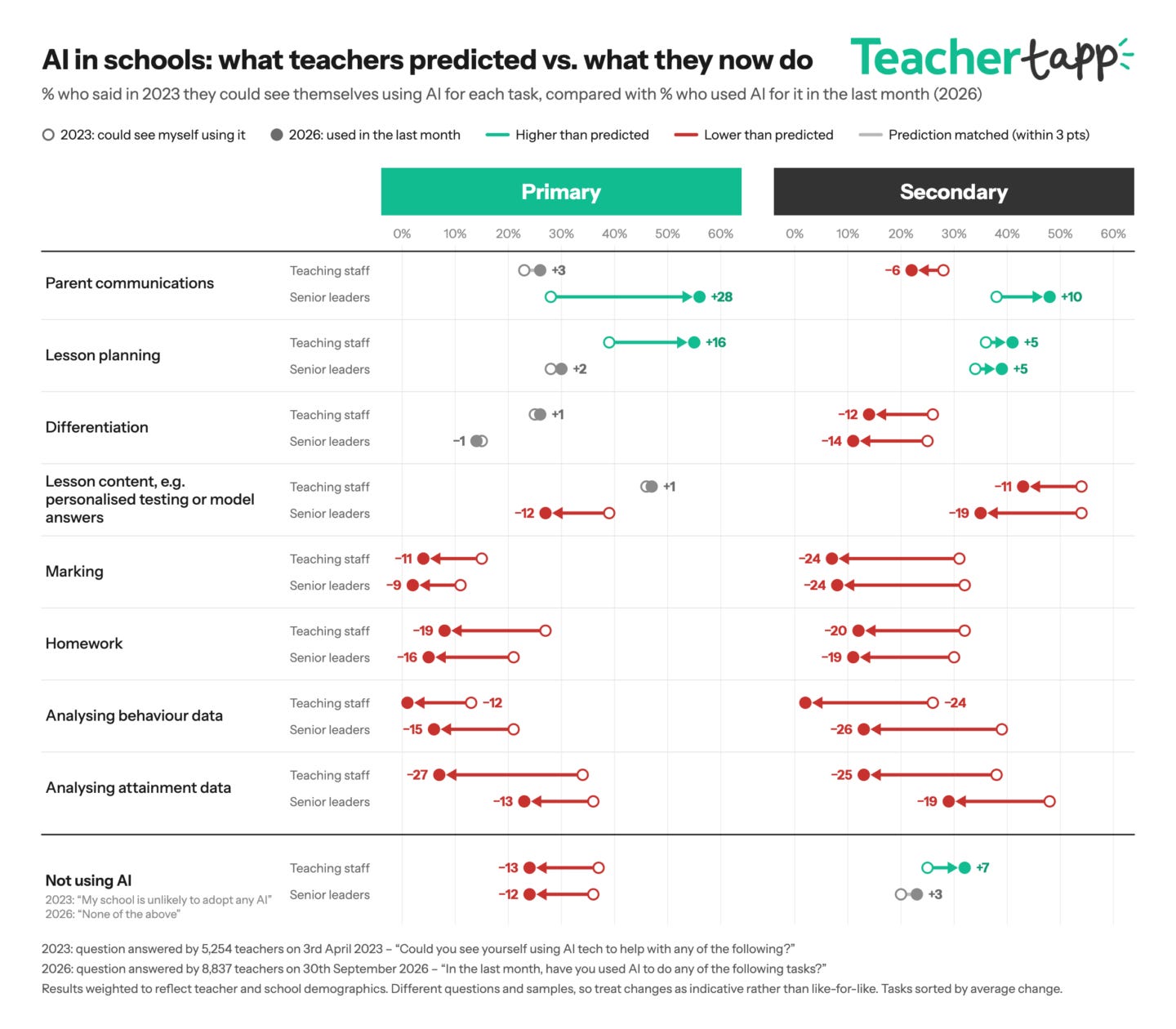
However, assessment and data tasks haven’t caught on like we thought they would (yet). The number of teachers reporting that they have used AI for marking, behaviour data and homework is lower than those who thought they would: 7% of secondary teachers used AI for marking vs 31% who thought they would.
Already, in three years, AI capabilities have changed hugely. So perhaps some of these predictions will prove to be correct; we just need to keep checking in!